
Second.dev
Revolutionize codebase maintenance with AI-driven automated upgrades.
Key Takeaways
- What it is
- Revolutionize codebase maintenance with AI-driven automated upgrades.
- Best for
- Automated Migrations
- Codebase Intelligence
- Secure Execution Environment
- Rating
- 4.6/5
What is Second.dev?
Second is an AI-native tool designed to simplify and enhance the maintenance and upgrading of enterprise codebases. This innovative platform focuses on automating the migration and upgrade processes, making it easier for engineering teams to manage and evolve large-scale software systems. By leveraging advanced AI, Second streamlines complex tasks, boosts productivity, and maintains high standards of code quality and security.
Second distinguishes itself through its advanced AI integration for both planning and executing codebase maintenance tasks. Its commitment to robust security, coupled with powerful codebase intelligence, positions it as a leading tool for managing complex software systems.
Second revolutionizes enterprise codebase maintenance by automating essential yet laborious tasks. Its combination of AI-driven automation, strong security measures, and customizable workflows makes it an invaluable tool for software engineering teams. Whether for large tech enterprises or startups, Second offers a significant advantage in managing and evolving complex software systems efficiently and securely.
Who is Using Second.dev?
Large Tech Companies
Utilizing Second to maintain and upgrade extensive codebases efficiently.
Startups
Leveraging the tool to scale technology without accumulating technical debt.
Educational Institutions
Integrating Second into their curriculum to teach advanced software engineering practices.
Financial Institutions
Such as Ridgeline, employing Second for managing and upgrading investment management software.
Uncommon Use Cases
Non-profits using Second to manage donor management systems; legal firms automating the maintenance of case management software.
Key Features
Rating Breakdown
Pricing Plans
Free Trial
- Offers a comprehensive free trial to explore the tool's features and capabilities
Subscription Plans
- Provides tiered pricing options suitable for different organizational sizes and needs
Which Second.dev plan should you pick?
Start with Starter for small repositories, upgrade to Pro for larger or customized migrations, and choose Enterprise for SSO, dedicated tenancy, or on-premises deployment.
Starter
Good for small repositories needing free access and basic GitHub-connected migration workflows.
Pro
Good for teams needing unlimited code changes, custom maintenance modules, and unlimited users.
Enterprise
Good for organizations needing dedicated tenancy, on-premises deployment, SSO, and enterprise support.
Second.dev Use Cases
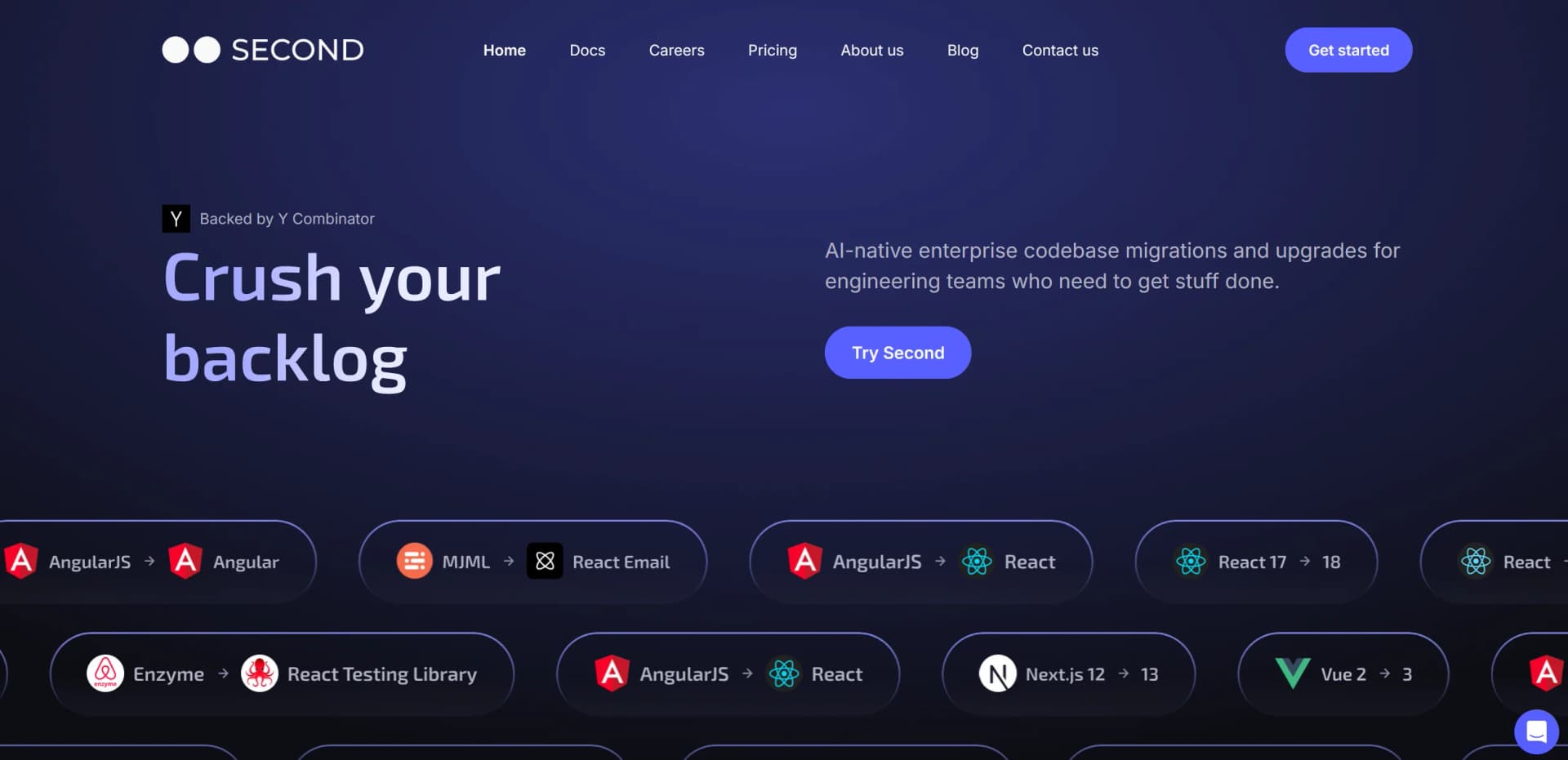
AngularJS to React migration
Connect an existing repository and run a migration module that restructures the codebase.
Outcome: A pull request containing the migration changes.
JavaScript to TypeScript conversion
Apply a specialized migration module to convert an existing JavaScript codebase.
Outcome: Automated code changes ready for review.
Framework upgrades
Run upgrade modules for frameworks and related dependencies.
Outcome: An updated codebase delivered through a pull request.
Test-suite migration
Migrate testing implementations such as Enzyme tests to React Testing Library.
Outcome: Generated changes for engineering review.
Workflow Ideas with Second.dev
Run a repository migration
- 1Connect your GitHub repository
- 2Select a migration module
- 3Review and merge the generated pull request
Upgrade a legacy framework
- 1Choose the framework upgrade task
- 2Let the Second agent analyze and modify the codebase
- 3Validate the pull request and merge the changes
How Second.dev fits into your stack
GitHub, Bitbucket, and GitLab Integration
Enables seamless connectivity with major code repositories.
YAML Customization
Offers flexibility in managing and executing projects.
Secure Cloud Environment
Ensures operations are conducted within a secure framework, protecting code and data.
Pros
- +Increased Productivity: Automates repetitive tasks, allowing developers to concentrate on more strategic and innovative work.
- +Enhanced Security: Maintains high standards of security and compliance, safeguarding sensitive code and data.
- +Scalability: Efficiently handles large-scale code transformations, making it suitable for enterprises of all sizes.
- +User-Friendly Interface: Provides an intuitive interface that simplifies migration and upgrade processes.
Cons
- −Initial Setup Complexity: Users may require time to become familiar with the YAML-based planning and customization features.
- −Limited Repository Support: Currently integrates only with GitHub, Bitbucket, and GitLab, which may limit its use for teams using other version control systems.
Limitations & when to consider alternatives
Known limitations
- Free repositories are limited in size. The free offering applies to repositories up to 1MB.
- Migration modules are specialized. Second is organized around purpose-built migration modules rather than unrestricted general-purpose development.
- Large deployments may require an enterprise plan. Dedicated tenancy, on-premises deployment, SSO, and other enterprise controls are reserved for enterprise customers.
Look elsewhere when
- You need a native mobile application.
- You need a public developer API.
- You need image analysis or document uploads.
How to Use Second.dev
- 1
Access a variety of tutorials on the Second website, ranging from basic setup to advanced feature usage, to help users maximize the tool's potential.
Who is Second.dev For?
Engineering teams
Automate repetitive codebase maintenance so engineers can focus on new product work.
Large enterprises
Modernize large or legacy repositories with managed migration workflows and enterprise deployment options.
Software developers
Use specialized agents and migration modules to update frameworks, dependencies, and code structure.
Frequently Asked Questions
What does Second do?
Second automates codebase migrations, upgrades, and other maintenance work using specialized AI agents.
How does a migration work?
Connect a repository, select a migration module, run the job, and review the resulting pull request.
Which repositories can be used for free?
The free offering supports repositories up to 1MB.
What kinds of migrations are supported?
Examples include AngularJS-to-React migrations, JavaScript-to-TypeScript conversions, and framework upgrades.
Does Second support enterprise deployments?
Enterprise offerings include dedicated tenancy, unlimited users, on-premises deployment options, and single sign-on.
Community reviews
1 review from people who use Second.dev.
Sign in to leave a review for Second.dev.
Thibault BM
Second.dev Alternatives
Looking for alternatives to Second.dev? Here are similar tools in the same category:
Learn to Master Second.dev
With Skill Leap courses
Get in-depth training on Second.dev and 50+ other AI tools with our expert-led video courses.
Start 7-Day Free Trial